Showing posts with label attraction. Show all posts

Wednesday, April 18, 2012

A Titanic Story

"I think that it was definitely a goal of Titanic to integrate a very personal, very emotional, and very intimate [story]... something that has a profound impact on your imagination..." - James Cameron

Photo Credit
In today's industry where publishers, Hollywood, music and even game developers are constantly in a race to 'remake' previous works or produce ones that are so similar to what has already been successful that they couldn't make it in the witness protection program, one wonders how it is possible to make something significant.

I recently had the pleasure to see the re-release of James Cameron epic as Titanic 3D. While I had seen pieces of this behemoth before, I never really saw it from beginning to end nor had I ever looked at this in terms of story. After watching I can only marvel at the culmination of elements that conspired to make it a true modern 'epic.'

Examining the story it seems to be a very simple romance. The boy from the wrong side of the tracks, the rich socialite that wants to escape her confining life, the jealous bad-guy fiancé and the helpful friends. On paper this sounds rather mundane, it very well sounds like almost any other romantic story in existence. So, where does this story become an epic?

The setting for the story is aboard the ill-fated cruise ship in 1912, this is not an original setting by any stretch of the imagination, There are no fewer than fifty different movies about the ship not counting the hundreds of documentaries. If we look at strictly the literary scene there are thousands and thousands of fictionalized accounts with a large percentage of them as romance stories. While tragic, this setting does not necessarily equate to an 'epic.'

If it's not the overall story or the setting, one might wonder if it's the characters that make this such a significant story. The characters are quite flat overall with a street kid, the socialite cheating fiancée, a controlling millionaire, and countless other rather flat characters. The superficial details to their lives, the personality traits and their interactions do not even pertain to an 'epic story.' Just sampling quotes reveals how dull or predictable most interactions are and how unusual some of the dialogs are.

Are the Events of the story what drives it to epic status? Outside of context you have a poker game, a guy that talks a socialite out of suicide, a dinner where socialites discuss status, a number of conversations about foreshadowing, a 'low-brow' party, a violent outburst from the millionaire towards his fiancée, a drawing session, a romantic moment between the star-crossed lovers, a moment of false imprisonment, survival on the sinking ship, treading water, character death and finally the heart/staircase. Is it the events that make this story epic? If it is the case then the story should be able to be moved to any other setting and have the same results.

Photo Credit
After looking at all of the elements it is abundantly clear at what makes this piece an epic, a story that is still successful 15 years later. It's the emotional punch.

The romantic story feels unique and new because the characters are drawn together in a believable way, reacting in an expected but emotional manner. The characters conveyed the emotions of each event in such a manner that even years after everyone knows the whole plot that people still react emotionally to Jack attempting to escape from the handcuffs or when Rose is slapped. The setting keeps the story together, it makes it a period piece that never feels out of place where technology can give away the age of the piece and pull the audience from it. These emotional punches culminate with the very moment that makes it an epic. Jack's death.

If the story had concluded with Jack and Rose making a new life together it would certainly be a happy ending but it would never even touch epic status. The only plausible ending was to take the one thing that the audience became so attached to throughout the journey, their relationship, and breaking it with something beyond their control. Old Rose's photos and the staircase scene give a sense of completion but also convey immense emotion. Even to this day, the audience can see an image from one of the 'emotional hits' and immediately feel it personally.

So what makes a story an epic? Is it unhappy endings? Is it the story alone? Is it the characters, their lives, the setting or the events? It is a culmination of all of these elements, each element that comes with it's own emotional hit and is then tied together. Creating a Titanic story is not about the individual elements or what they represent but the emotions that they convey.
Monday, February 20, 2012

Carnival of Thrills

Every composition is its own thriller, a unique and compelling ride that provides the necessary suspense, excitement and satisfaction to compel the audience to the conclusion.

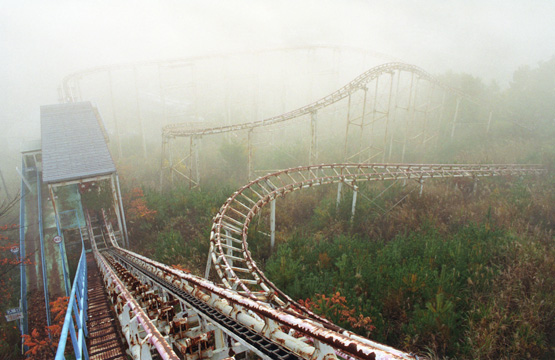
Many authors equate a strong narrative to a roller-coaster, a thrill ride with countless ups and downs, sharp twists in the track and blind drops that keep the participants on the edge of their seats. To a degree this is a strong analogy for the perfectly balanced narrative.

Photo Credit
When participants choose a roller-coaster they have a certain set of preconceived notions about the experience and the expectations of what will be experienced. Presentation is at the foremost, the coaster typically has a theme be it horror, adventure or even action heroes. This establishes the tone for the ride and gives participants a set of emotions to expect. This then leads to the actual ride, the anticipation of the excitement, the suspense as the the coaster climbs each rise in the track, the fear as the drops are perceived, the excitement of the pacing and ultimate satisfaction from the whole experience.

Any narrative composition, even life, can be easily compared to a thrill ride like a roller-coaster but while this is sufficient in most cases it's not entirely accurate.

The reality of a carnival ride like a roller-coaster is that the participant is aware of what's in store for them. The track is easily visible, like a reader selecting a specific genre but in all instances, the strongest compositions emulate life. This is where the carnival ride diverges greatly from the single track roller-coaster ride.

Where a narrative does follow a path it is not a singular track bound for conclusion. A narrative, as life, is predicated on following choice and consequence. A singular choice may cause the track to drop from under your feet or climb to great heights. When characters in a narrative are subject to their own choices and the consequences of those choices, the audience can better relate than if it was an on-rails ride.

The individuals in a narrative are not merely characters designed to support the main attraction like props on a roller-coaster ride to add atmosphere. Ever individual is a product of their choices and the more that these connections are explored, the more the audience becomes invested in the composition. A strong narrative, like life, is not a restrictive roller-coaster but a full carnival of thrills. Every path is hidden,every ride, adventure and event concealed until the appropriate choices are made.


“Writing is not life, but I think that sometimes it can be a way back to life.” 
― Stephen King, On Writing

Tuesday, February 7, 2012

Suspended Perceptions

Any narrative journey is a confluence of events, lives and emotions. It is a carnival ride that the participants are thrown onto and it's up to the gathered crowd to judge the entertainment value of watching participants on the rides.

Like any carnival there are a great variety of rides available and a number of ways that the crowds can experience them. Each can be equated to a narrative avenue and an emotional outlet that is available to experience.

Some individuals prefer to experience the ride first-hand, experiencing all of the emotions, events and the personal interactions along with the participants. In the narrative journey these adventurous individuals would choose a first-person perspective, they want to experience what the participants experience.

Photo Credit
Others prefer to watch participants reactions to the rides, enjoying not being on the ride that is evoking all of the emotions in its participants. Honestly, it can be quite the experience watching the brave climb aboard the Orbiter and then watching them scream in terror as they are hurled about. These observers typically choose the third-person perspective for their narrative journey.

Between the adventurers and the observers the carnival rides offer endless opportunities and countless experiences. Examining these attractions from an outside perspective it is possible to identify the key emotions that each ride is designed to exploit.

Regardless whether it's the Tunnel of Love, a calm ride that brings the participants closer together or  a Tilt-a-whirl that offers non-stop excitement each is an abstracted concept focused on one singular emotion that exploits the behaviors of participants. Every participant boards a ride with their own expectations and perceptions of what the ride will convey to them. In the narrative sense these are all just genres. Just as the participant is aware what each ride is meant to convey, so too is the reader aware of what each genre entails.

Interestingly, despite the cliches and the preconceived notions participants and observers have, they still enjoy the ride.

Tuesday, December 6, 2011

Abstracting Layers

Depth, Dimension, Layers…

As a narrative piece is composed, one of the difficulties of framing a specific point as the subject of the narrative is establishing the sense of depth in the composition.

Often a visual composition will rely on layering to add a sense of depth and even time to the piece. A narrative composition can quite frequently utilize similar techniques to bring that composition into greater focus, bring it to life.

Adding depth to a narrative is achieved through layering interaction dynamics and narrative history.

Photo Credit
Interaction dynamics are the implied and explored relationships within the narrative. These can be the relationships between subjects or between subjects and setting. Implied relationships are not overt reactions between subjects but the secondary inferred relationships. In a visual sense the subjects would be juxtaposed to demonstrate hidden emotions or draw tension. These are quite common in romantic narratives as two subjects awkwardly avoid interactions.

The explored relationships are overt dynamics, emotions and interactions are direct. Visually there are direct correlations between subjects or subjects and setting. These can be further layered with different levels of emotions, interactions and relationships. All of these are typically the make new friends, adversaries and love interests subject interactions.

The interaction dynamics of both implied and explored relationships add layers to the composition, provide a sense of depth to the interactions.

A visual composition can frequently capture a still moment in time, but it can also appear flat and superficial. While in a narrative it is possible to convey a linear progression of time, like a visual composition it can also appear flat and superficial.

Through narrative history it is possible to layer a composition with additional depth and dimension. The composition demonstrates a history for the subjects through details of worn settings, memories of previous events and relationships built on events not within the composition.

As any visual composition becomes more interesting with layers of interaction dynamics and narrative history so to does a narrative composition. The flat one-dimensional take on a narrative timeline or strictly overt interactions leaves a flat, superficial image. Adding layers of interactions, history and detail together brings the piece to life.

Monday, July 18, 2011

Drawing the Thrills

Fear, Thrills, Excitement…

As with any ride that is artfully crafted, participants are intrigued by the anxiety of not knowing what will happen next. The steady pressure of this anxiety, this fear creates a tension and through it a suspense that drives the narrative forward.

"Monsters are real, and ghosts are real too. They live inside us, and sometimes, they win." - Stephen King


The suspense may drive the piece forward but without a release the characters and audience will be too fatigued by the end of the piece to enjoy the ride. Many seek out thrills to experience that rush, the race of their heartbeat, the fear of the unknown and the feeling of relief that comes once they've overcome that obstacle. It is a psychological need to understand, a fascination with that which they can not comprehend because it is so different from our everyday lives. That fascination stems from a need to find out how much fear the individual can tolerate and ultimately the sense of satisfaction that comes from being able to endure that anxiety.

In a roller-coaster it is the anxiety of not knowing what comes next that makes the ride so appealing but it is the excitement that makes the ride satisfying. The longer the anxiety is permitted to build, the more tension the participants will feel and by extension the greater the satisfaction will be for the release of that tension.

While the tension of a ride may continue to build the conditional stress experienced is still subject to the individual's tolerances for prolonged anxiety. This means that while a ride may layer anxiety and tension to keep applying pressure the individual has physiological tolerances to that stressor. The individual can become exhausted and in terms of a narrative this means they will put the story down. Exciting moments are release points for the tension. If the excitement does not address the current anxiety or tension in any way then it will not serve as a release but another form of tension.

Thrilling moments are derived from an equal balance of anxiety and the satisfaction of that release. Like a roller-coaster, if the ride climbs to an epic height the drop, excitement, should be of equal height unless there is a need to keep partial stress. This can mean a greater satisfaction from the climax of the ride however, it also means greater chances of fatigue along the journey.

Thrills are created by provoking emotional anxiety both for the character and the reader through exploring that which they can not understand. What is it like to have someone close murdered? What is it like the have two people fall in love with the same person? What is it like to catch a criminal? Stop a supernatural horror? People look to experience a thrill, something that they do not experience on a routine basis. To deliver that thrill, it needs to come in equal parts of tension and excitement. If you reduce the tension, the excitement will not have the same impact. If you reduce the excitement, the satisfaction will fade with it. The perfect thrill is one that is built with suspense and has partial releases (pay-offs) until the close.

Romance example: Antoine has a crush on Jayne but she doesn't know he exists. Antoine set about trying to get her attention. (Tension) After a period he finds a means of talking with her. (Partial-Release)  Jayne smiles at him passing in the hall. (Partial-Release) Mean Ex-BF threatens Antoine, they walk away together. (Tension) Antoine confronts EB. (Tension) Jayne admits she's in love with Antoine. (Release)

Supernatural Thriller example: Antoine discovers people are disappearing. Secretly has crush on Jayne. (Tension) Discusses with friends and friends confirm more disappearances. (Tension) Starts working with Jayne to find missing people. (Partial-Release) In-fighting about how to proceed as friends disappear. (Tension) Find clues about disappearances, in-fighting between them due to tension. (Partial-Release, relationship tension) Antoine admits crush to Jayne, interrupted before Jayne can react. (Tension) Antoine saves Jayne form supernatural threat. (Partial-Release- still relationship tension) Together they stop the threat and Jayne admits to being in love with Antoine. (Release) 

Ultimately, if you build too much tension without at least a partial release it is akin to queuing in line for hours to get on a roller-coaster that goes down one dip and dumps you off at the gift shop.

Sunday, March 13, 2011

Drawing the Spectacle

Conflict, carnivals, spectacles...

At the core of any narrative is the conflict whether that is conflict between characters, external factors or even within a solitary character. The conflicts are the attractions for an audience, they're the rides that either draw or turn away participants.

Like a carnival, the core attractions will have a cohesive tone to attract the primary audience and convince them to participate. The core attraction in the narrative is often one of primary narrative themes; good versus evil, man versus nature etc. The premise conflict is the primary spectacle to draw the attention of an audience.

The creator of the work is no different than the ring master or the carnival manager. Every attraction has it's purpose, if it under-performs than it shall be cut. To the writer these are the revisions.

Once the audience can identify the major attractions they begin to explore the carnival. Not every attraction will suit every participant but every attraction should be able to obtain its' own crowd. These smaller attractions are designed to hold the attention of attendees until the they can experience the major spectacles. These attractions are often conceptualized character conflicts that examine both external and internal contention. Relationships, feuding friends moral dilemmas all orchestrated to maintain the attention of the masses.

As the attractions are selected and assembled the arrangement becomes key. If there are too many attractions the participants will grow tired before experiencing the full extent of the project. If there are too few attractions they will lose interest quickly. Spacing the attractions out at regular intervals will keep the interest of participants and maintain the tone.


When the architect begins crafting their piece, they must ask is this a sufficient spectacle to draw the crowd? Are the attractions enough to entertain? Is the main attraction a ride that others want to take?
 

PW Creighton: The Surveillance Report Copyright © 2011 -- Template created by PW Creighton -- Powered by Blogger