Showing posts with label Suspense. Show all posts

Wednesday, May 16, 2012

Intriguing Observations: Live. Write. Thrive.


The Intriguing Observations series was created to gather some of the greatest supporters and bloggers to provide their own insight on all things creative both in their ventures and their techniques. This week on the guest series is another all-star supporter and NY Times Bestselling author, Bob Mayer.

~~~~~~~~~~~~~

No Matter the Genre, All Great Books Start With a Great Idea

The kernel idea is the Alpha and the Omega of your book, no matter what genre you are writing in.  By that I mean a single idea starts your creative process and it completes it.  It’s what you begin with and at the end of the manuscript, everything in the book points toward it.

The kernel idea is the foundation of your novel.  When I say idea, I don't necessarily mean the theme, although it can be.  Or the most important incident, although it can be.  But it can also be a setting.  It can be a scene.  It can be a character.

It is simply the first idea you had that was the seed of your novel.  All else can change, but the idea can’t.  It might be a place; a person; an event; a moral; whatever.  But you did have it before you began writing and you must remember it as you write.  If you don't, your story and style will suffer terribly.  You should be able to tell your idea in one sentence.  And repeat it to yourself every morning when you wake up and prior to writing.  Knowing it will keep you on track.

Every new book I begin, I write out this one sentence on a word document as the very first writing I do.  I print it out and put it where I can constantly see it. If you can't do remember this one sentence, then you need to backtrack through your thought processes and find it, because you had to have had it.  Everything starts from something.  Idea is not story.  Because every idea has been done, but every story hasn't.  The kernel idea is the one thing in your manuscript that cannot change.

In one of my early novels, the original idea was an action:  What if Special Forces soldiers had to destroy an enemy pipeline?  That's it for Dragon Sim-13.  Not very elaborate, you say.  True.  Not exactly a great moral theme.  Right.  But with that original idea there was a lot I could do and eventually had to do.  I had to change the target country after the first draft.  But that was all right because I still had the idea.  I had to change characters, but that was fine too, because it didn't change my idea.  I had to change the reason why they were attacking a pipeline, but again, the original idea was the same.

You will have plenty of latitude for story after you come up with your kernel idea; in fact, I sometimes find the finished manuscript turns out to be different from what I had originally envisioned, but one thing is always true: that kernel idea is still there at the end as the Omega.

For my first kernel idea, I made it as simple as possible to enable me to focus on the writing because when I was in the Special Forces my A-Team had run a similar mission on a pipeline.   Since I had a good idea what would happen in the story, I could concentrate on the actual writing of the novel.
I've sat in graduate literature classes and heard students say:  "The author had to have a moral point in mind when they wrote that book."  I agree, but sometimes it is not at the forefront of the story.  Many authors write simply to tell a story started by that kernel idea, which indeed might be a moral point, but sometimes is a story that they wanted to tell and the theme developed subsequently.

Photo Credit
A moral or theme (screenwriters call it intent) always does appear in a book by the time it’s done.   No matter what conscious expectations or thoughts an author has when they start writing, a lot more appears in the manuscript than they consciously anticipated.

After you have that kernel idea, you should spend a lot of time wrestling with it and consciously uncover your feelings and thoughts about it.  I try to look at my main characters and determine what will happen to them emotionally, physically and spiritually as they go through the story.  Who are they at the beginning of the story and who are they at the end?

This is an example of being aware of what you are doing.  I said above that not all authors have a conscious theme when they write a novel, but experience has taught me that it is better to have your theme in your conscious mind before you start writing.  It might not be your original idea, but it will definitely affect your characters and story.

The reason it is important to have a theme in mind is because people want to care about what they read and the characters.  If there is some moral or emotional relevance to the story they read, they will become more involved in the story and enjoy it more.  Even if the reader doesn't consciously see it either.  
Let me give you more examples of ideas I’ve used and gotten published:

What if the force that destroyed Atlantis ten thousand years ago comes back and threatens our world?  Atlantis series of books.

What if mankind didn’t originate the way we think we did?  Area 51 series.

What if Japan succeeded in its atomic bomb program at the very end of World War II and one of those bombs was hidden at the base of the Golden Gate Bridge?  The Gate

Another way to try to figure out what the core of your novel is this:  What is the climactic scene?  This is when the protagonist and antagonist meet to resolve the primary problem that is the crux of the novel.  This is what the entire book is driving towards.

Where’s the shiver?

What excited you so much that you decided to sit in the dark and writer 100,00 words.  That’s not normal, in case no one’s told you.  What excites people you talk to about your book?  I know I’m on target with an idea if others pick up my excitement when I discuss it.

Remember, as a writer, you are selling emotion and logic.  And Kirk always trumps Spock.
A key to selling your book is being able to communicate this shiver to other people.  To get them as excited as you were when you first began writing.


Bob Mayer is the NY Times Bestselling author of factual thrillers. He steeps his stories in military, historical and scientific facts, then weaves those facts through fiction creating an exciting ride for the reader.  He’s a West Point graduate, former Green Beret, and author of more than 50 books all available in eBook that have sold over 4 million copies.  He’s been on bestseller lists in thriller, science fiction, suspense, action, war, historical fiction and is the only male author on the Romance Writers of America Honor Roll.  He is one of the bestselling indie authors in the country.
Twitter: Bob_Mayer
Sites: www.bobmayer.org   www.whodareswinspublishing.com


Wednesday, March 14, 2012

Intriguing Adaptations

In any creative composition that desires to convey a narrative, the piece strives to emulate life. Through the emulation it is possible for others to connect with the work.

Individuals that perceive the composition can empathize with others in familiar situations, they can recognize individuals and even understand how narrative thoughts could come together because it is familiar. Establishing relatable elements expands the scope of the piece, changes it into something personal, something that can convey a concept into the very thought process of others.

Photo Credit
Selecting and manipulating elements to make a composition relatable is only one part of a larger challenge, making the piece interesting to an external perspective. Individuals have their own perceptions, preconceived notions that filter any composition.

While establishing the connection with the piece creates a given level of interest, it does not guarantee that the piece will have enough innate interest to keep the viewer engaged.

The most fundamental element of any narrative that grabs an individual's attention and keeps it is adaptation.


Every narrative, every piece is driven by the fundamental concept of human adaptation, individual adaptability. People are naturally drawn to stories because of the innate fascination with observing how other people adapt to situations. Regardless of whether it's how someone would adapt to the death of a loved one, the stress of saving lives, catching a murderer, caring for a child or even switching careers the interest is piqued.

Since most people are unable to experience all the possibilities of human adaptability they are innately drawn to experience these adaptations through others. It doesn't matter if it's called coping, overcoming something or character growth, it is human adaptation and we are always interested. Mixing relatable elements into the piece only assists in emphasizing our interest in that adaptation.

Monday, February 20, 2012

Carnival of Thrills

Every composition is its own thriller, a unique and compelling ride that provides the necessary suspense, excitement and satisfaction to compel the audience to the conclusion.

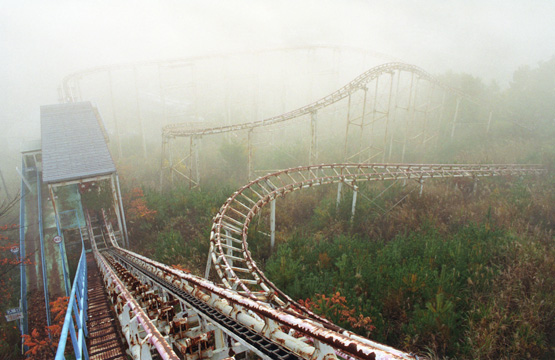
Many authors equate a strong narrative to a roller-coaster, a thrill ride with countless ups and downs, sharp twists in the track and blind drops that keep the participants on the edge of their seats. To a degree this is a strong analogy for the perfectly balanced narrative.

Photo Credit
When participants choose a roller-coaster they have a certain set of preconceived notions about the experience and the expectations of what will be experienced. Presentation is at the foremost, the coaster typically has a theme be it horror, adventure or even action heroes. This establishes the tone for the ride and gives participants a set of emotions to expect. This then leads to the actual ride, the anticipation of the excitement, the suspense as the the coaster climbs each rise in the track, the fear as the drops are perceived, the excitement of the pacing and ultimate satisfaction from the whole experience.

Any narrative composition, even life, can be easily compared to a thrill ride like a roller-coaster but while this is sufficient in most cases it's not entirely accurate.

The reality of a carnival ride like a roller-coaster is that the participant is aware of what's in store for them. The track is easily visible, like a reader selecting a specific genre but in all instances, the strongest compositions emulate life. This is where the carnival ride diverges greatly from the single track roller-coaster ride.

Where a narrative does follow a path it is not a singular track bound for conclusion. A narrative, as life, is predicated on following choice and consequence. A singular choice may cause the track to drop from under your feet or climb to great heights. When characters in a narrative are subject to their own choices and the consequences of those choices, the audience can better relate than if it was an on-rails ride.

The individuals in a narrative are not merely characters designed to support the main attraction like props on a roller-coaster ride to add atmosphere. Ever individual is a product of their choices and the more that these connections are explored, the more the audience becomes invested in the composition. A strong narrative, like life, is not a restrictive roller-coaster but a full carnival of thrills. Every path is hidden,every ride, adventure and event concealed until the appropriate choices are made.


“Writing is not life, but I think that sometimes it can be a way back to life.” 
― Stephen King, On Writing

Monday, January 16, 2012

Abstracting Speed and Clarity

Expressing the focus of a composition is a delicate balance between the primary subject and surrounding details of the piece.

The balancing of primary subject and supporting details is most readily apparent in visual compositions from mediums such as photography and cinematography. The speed of the composition determines the clarity of the overall composition.

In photography and subsequently cinematography, the film speed determines a number of components within a given composition. Most prominently the speed determines the level of detail and clarity of the the piece. The restriction of adjusting the speed at which a composition is captured is that as the speed increases to capture fast subjects with more clarity, the more detail is sacrificed.

Photo Credit
Film, as well as digital, requires larger film grains to capture at faster speeds. As the film speed is increased, the grains become noticeably larger and affect the level of detail capable in the image. While faster speed allows for capturing a subject with more stability the faster the subject, the faster speed required to capture it.

The concept of speed and clarity is just as visible in a narrative composition as it is in the visual arts. As the speed of the composition increases, the subject becomes clearer as the focus but the level of detail is reduced as the speed - pacing is increased.

In a narrative the descriptors, dialog tags and even breaks either page or chapter are the equivalent 'film grain' in the piece. Increasing the pace of the narrative makes these elements seem larger and even distorted compared to the piece. The primary subject becomes even clearer but the surrounding details begin to lose detail to keep that pace. While reducing the speed of the piece too much can make the overall composition seem unfocused.

Every composition is a delicate balance of speed and clarity. Increasing the details reduces the focus of the primary subject and slows the pace. Likewise, too little detail yields a fast-paced blur of a composition.


Monday, July 11, 2011

Assigning Stressors

As the narrative roller-coaster unfolds it is not simply the suspense and excitement that drives the piece forward but the tension, the taut emotions that consume both characters and audience

Every piece begins with anticipation, presumptions about events and serves to draw an emotional connection between the audience and the ride. It is that emotional connection that a creator can draw upon to influence perceptions and elevate their work beyond the initial hook.

An audience's connection begins with anticipation as the first conflict is assigned to the character. This is the prominent conflict that is designed to both introduce the audience to the characters and test the characters. Psychology describes this conflict as a stressor and the emotion associated with an unresolved stressor is the foundation of every narrative, Tension. Through the introduction of this unresolved stressor the narrative is compelled forward and providing the connection has been initially been established the audience will be driven to find a resolution for the stressor based upon the General Adaptation Syndrome model.

In the General Adaptation Syndrome model physiologists describe stress as taking place in the three phases of Alarm, Resistance and Exhaustion. In the alarm phase the body will react to initial stressor with adrenaline and commonly the 'fight or flight response.' The Resistance phase takes place under a sustained tension and represents how the individual will either cope or remove the stressor. As the final phase of the GAS model exhaustion takes hold on the subject and the body's systems are compromised. Abstracting this concept to the characters in a story, these stressors can not only develop new conflicts but also represent additional depth to the characters. As the tension continues to mount across time for the characters it can have a profound impact on their behavior.

A story is a taut ride, a thrilling roller-coaster that takes unexpected turns and drops to keep the audience enraptured. The suspense is born of anxiety, a tension that is drawn in such a manner as to keep both the characters and audience moving through the story. Applying different stressors can keep tension high, keep the audience engaged, but as with any stressor, if there is no relief exhaustion can set in and break the piece.

Tuesday, July 5, 2011

Drawing the Paranoia

Suspense, anxiety, fear….

While every story is its' own thriller, a roller-coaster of suspense, tension and excitement it is the writers' ability to wield the elements to enhance the connection between the narrative and the audience that defines the nature of the piece. Through closer examination of these elements it is possible to not only further enhance a piece but also further define the audience of a piece.

"Being prepared for almost anything, he was not, by any means, prepared… for nothing" - Charles Dickens, A Christmas Carol.


Suspense is an imperative to any piece, it defines the need for an audience to continue through a story. It embodies the questions that need answers. Will the character fall in love with the protagonist? Did they do the right thing by buying that house? Who committed the murder? Will they stop the antagonist? These are only a few of the many questions that are crafted for not only the audience but for the characters in a piece to answer. These are the driving force that keeps a piece moving forward but what is the defined use?

The element of suspense is a feeling of uncertainty and strong anxiety about the outcome(s) for certain actions. Most commonly it is utilized in the build-up right before a grand or dramatic moment to enhance the impact of that moment. In a romance it can mean the silence before the love interest responds to the almighty ILY from the protagonist. In a mystery it can be the interrogation of a suspect, while in a thriller it can be a race to stop something from happening. There is more than one way to utilize suspense in a narrative though.

One of the most powerful uses of suspense is not genre specific but it does require an artful use and a delicate balancing act. Suspense can be established and rather than releasing the tension through excitement, the excitement of the piece only serves to further enhance the suspense. In classic horror and thriller fashion it is known as "Nothing is Scarier." In short this trope means that as the suspense builds it is more powerful if the excitement or release moment comes without an actual release. This same device can be utilized in any genre, it is not horror or thriller specific but these are genres that use it openly. In a diametric example, Romance this could mean the protagonist admits the ILY to the interest but before the interest can respond something intervenes. The audience is left with that suspense while something adds an additional layer to the suspense.

There are roughly three variants of this device that are very common to horror and thrillers. These are the classic, full and has been variants. In the classic horror example suspense is built as the audience anticipates something to jump out from the dark and does. This is almost viewed as cliche now and it utilized in almost every horror and thriller. Abstracting this is simply suspense building up to a release point that is inevitable and often expected. The second full variant of this is often the most powerful of the three variants. The suspense is built as the audience anticipates something bad to happen, a monster to jump out of the dark but something intervenes to prevent release point. The audience still anticipates the attack, the monster but it doesn't come. Abstracting this variant we have suspense building to the point of release but the release point never comes. This is a very powerful element for most mystery, thriller and horror narratives. The final is the has been variant and is now quite common in horror stories. Often this is seen horror movies as a character expecting something in the darkness, another character distracts them and then the 'whatsit' attacks. Abstracting this variant suspense is built to the point of release but something intervenes to delay the release point.

Suspense is the key element in a taught story. It is the basis for many thrillers and horror stories but the elements are not exclusive to a single genre. As a writer draws the suspense of their piece it is possible to turn any story into a suspenseful page turner regardless of genre. What are the suspenseful elements of your piece?
 

PW Creighton: The Surveillance Report Copyright © 2011 -- Template created by PW Creighton -- Powered by Blogger