Showing posts with label carnival. Show all posts

Monday, February 20, 2012

Carnival of Thrills

Every composition is its own thriller, a unique and compelling ride that provides the necessary suspense, excitement and satisfaction to compel the audience to the conclusion.

Many authors equate a strong narrative to a roller-coaster, a thrill ride with countless ups and downs, sharp twists in the track and blind drops that keep the participants on the edge of their seats. To a degree this is a strong analogy for the perfectly balanced narrative.
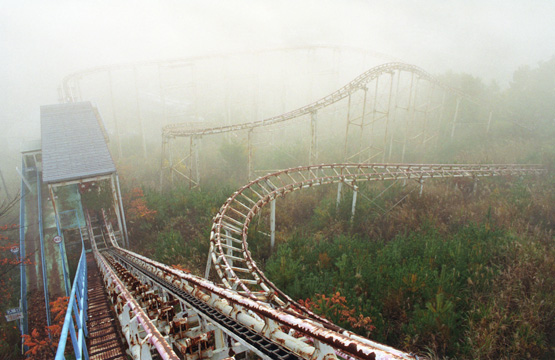
Photo Credit
When participants choose a roller-coaster they have a certain set of preconceived notions about the experience and the expectations of what will be experienced. Presentation is at the foremost, the coaster typically has a theme be it horror, adventure or even action heroes. This establishes the tone for the ride and gives participants a set of emotions to expect. This then leads to the actual ride, the anticipation of the excitement, the suspense as the the coaster climbs each rise in the track, the fear as the drops are perceived, the excitement of the pacing and ultimate satisfaction from the whole experience.

Any narrative composition, even life, can be easily compared to a thrill ride like a roller-coaster but while this is sufficient in most cases it's not entirely accurate.

The reality of a carnival ride like a roller-coaster is that the participant is aware of what's in store for them. The track is easily visible, like a reader selecting a specific genre but in all instances, the strongest compositions emulate life. This is where the carnival ride diverges greatly from the single track roller-coaster ride.

Where a narrative does follow a path it is not a singular track bound for conclusion. A narrative, as life, is predicated on following choice and consequence. A singular choice may cause the track to drop from under your feet or climb to great heights. When characters in a narrative are subject to their own choices and the consequences of those choices, the audience can better relate than if it was an on-rails ride.

The individuals in a narrative are not merely characters designed to support the main attraction like props on a roller-coaster ride to add atmosphere. Ever individual is a product of their choices and the more that these connections are explored, the more the audience becomes invested in the composition. A strong narrative, like life, is not a restrictive roller-coaster but a full carnival of thrills. Every path is hidden,every ride, adventure and event concealed until the appropriate choices are made.


“Writing is not life, but I think that sometimes it can be a way back to life.” 
― Stephen King, On Writing

Tuesday, February 7, 2012

Suspended Perceptions

Any narrative journey is a confluence of events, lives and emotions. It is a carnival ride that the participants are thrown onto and it's up to the gathered crowd to judge the entertainment value of watching participants on the rides.

Like any carnival there are a great variety of rides available and a number of ways that the crowds can experience them. Each can be equated to a narrative avenue and an emotional outlet that is available to experience.

Some individuals prefer to experience the ride first-hand, experiencing all of the emotions, events and the personal interactions along with the participants. In the narrative journey these adventurous individuals would choose a first-person perspective, they want to experience what the participants experience.

Photo Credit
Others prefer to watch participants reactions to the rides, enjoying not being on the ride that is evoking all of the emotions in its participants. Honestly, it can be quite the experience watching the brave climb aboard the Orbiter and then watching them scream in terror as they are hurled about. These observers typically choose the third-person perspective for their narrative journey.

Between the adventurers and the observers the carnival rides offer endless opportunities and countless experiences. Examining these attractions from an outside perspective it is possible to identify the key emotions that each ride is designed to exploit.

Regardless whether it's the Tunnel of Love, a calm ride that brings the participants closer together or  a Tilt-a-whirl that offers non-stop excitement each is an abstracted concept focused on one singular emotion that exploits the behaviors of participants. Every participant boards a ride with their own expectations and perceptions of what the ride will convey to them. In the narrative sense these are all just genres. Just as the participant is aware what each ride is meant to convey, so too is the reader aware of what each genre entails.

Interestingly, despite the cliches and the preconceived notions participants and observers have, they still enjoy the ride.

Wednesday, February 1, 2012

Intriguing Observations: How Choreography Helps a Scene

The Intriguing Observations series was created to gather some of the greatest supporters and bloggers to provide their own insight on all things creative both in their ventures and their techniques. This week on the guest series is another all-star supporter and an outstanding wordsmith Jill Kemerer.


~~~~~~~~~~~~


Each October I spend hours choreographing a dance routine for our school’s cheerleading squad. First, I select fast-paced, appropriate music—no suggestive lyrics or cursing—then I think of possible sequences, often searching YouTube for new-to-me dance moves.

The real choreography doesn't begin until I throw on my yoga pants and practice performing eight counts. It’s a fun but arduous process of repeating moves until they’re memorized and then deciding which order to put them in. Often, I have to throw out entire eight counts for being too difficult, too fast, or too confusing. When I have the routine finished, I rehearse it often to keep it fresh until practices begin in December.

Photo Credit
As a fiction writer, I incorporate choreography in every scene. If you’re a writer, you do too, but you might not have realized it. First, we select the location of the scene the same way I select music for a dance. It must be the appropriate locale for the season—we wouldn’t put our characters on a sunny beach during a Canadian winter—and it should be a venue where our characters would logically appear.

After we’ve determined the setting, we have to figure out how to start the scene, who is in the scene, and what the viewpoint character wants to accomplish. The real choreography doesn’t begin until we open up our manuscript and start writing. I don’t believe I’ve ever written a scene where the characters didn’t move. Even if the scene is mostly in one character’s head, movement should occur. Maybe she stomps to the kitchen in frustration as she tries to figure out who sabotaged her project? Or he tries to ignore his problems by flipping through the television stations at the speed of light?

When there are several characters in a scene, the choreography gets trickier. We have to clarify who speaks, responds, and walks away when the scene is crowded or we risk losing the reader.

If you, like me, overuse gestures from scene to scene, choreography can help. Visualize the interaction between characters and strive to find the unique actions they take. If nothing new comes to mind, picture them moving within the scene.

Try to provide tension and conflict even in their actions. Let’s say your characters have reluctantly paired to solve a crime. Maybe one shuffles slowly through life and takes the time to notice little details, while the other has a goal and won’t be distracted by anything. You could show their personality traits by setting the scene in a store and having one striding to the counter to question the clerk while the other picks up merchandise and examines walls, prices, even the other customers. The dialogue will remain the same, but the little actions tell a reader much more than their words ever could.

In many ways, our characters’ interaction is a dance. We simply choreograph their movement on each page and throughout the story.

How do you choreograph your characters’ actions in a scene?


Jill Kemerer writes inspirational romance novels. Coffee fuels her mornings; chocolate, her afternoons. A former electrical engineer, she now enjoys a healthy addiction to magazines, fluffy animals, and her hilarious family. She is a member of ACFW and RWA and also serves as vice-president of MVRWA. Jill is represented by Rachel Kent of Books & Such Literary Agency.

To learn more about Jill, head to her website, www.jillkemerer.com, stop by her blog, http://jillkemerer.blogspot.com, be friends with her on Facebook (http://www.facebook.com/AuthorJillKemerer), and follow her on Twitter (http://twitter.com/#!/jillkemerer).


Monday, July 18, 2011

Drawing the Thrills

Fear, Thrills, Excitement…

As with any ride that is artfully crafted, participants are intrigued by the anxiety of not knowing what will happen next. The steady pressure of this anxiety, this fear creates a tension and through it a suspense that drives the narrative forward.

"Monsters are real, and ghosts are real too. They live inside us, and sometimes, they win." - Stephen King


The suspense may drive the piece forward but without a release the characters and audience will be too fatigued by the end of the piece to enjoy the ride. Many seek out thrills to experience that rush, the race of their heartbeat, the fear of the unknown and the feeling of relief that comes once they've overcome that obstacle. It is a psychological need to understand, a fascination with that which they can not comprehend because it is so different from our everyday lives. That fascination stems from a need to find out how much fear the individual can tolerate and ultimately the sense of satisfaction that comes from being able to endure that anxiety.

In a roller-coaster it is the anxiety of not knowing what comes next that makes the ride so appealing but it is the excitement that makes the ride satisfying. The longer the anxiety is permitted to build, the more tension the participants will feel and by extension the greater the satisfaction will be for the release of that tension.

While the tension of a ride may continue to build the conditional stress experienced is still subject to the individual's tolerances for prolonged anxiety. This means that while a ride may layer anxiety and tension to keep applying pressure the individual has physiological tolerances to that stressor. The individual can become exhausted and in terms of a narrative this means they will put the story down. Exciting moments are release points for the tension. If the excitement does not address the current anxiety or tension in any way then it will not serve as a release but another form of tension.

Thrilling moments are derived from an equal balance of anxiety and the satisfaction of that release. Like a roller-coaster, if the ride climbs to an epic height the drop, excitement, should be of equal height unless there is a need to keep partial stress. This can mean a greater satisfaction from the climax of the ride however, it also means greater chances of fatigue along the journey.

Thrills are created by provoking emotional anxiety both for the character and the reader through exploring that which they can not understand. What is it like to have someone close murdered? What is it like the have two people fall in love with the same person? What is it like to catch a criminal? Stop a supernatural horror? People look to experience a thrill, something that they do not experience on a routine basis. To deliver that thrill, it needs to come in equal parts of tension and excitement. If you reduce the tension, the excitement will not have the same impact. If you reduce the excitement, the satisfaction will fade with it. The perfect thrill is one that is built with suspense and has partial releases (pay-offs) until the close.

Romance example: Antoine has a crush on Jayne but she doesn't know he exists. Antoine set about trying to get her attention. (Tension) After a period he finds a means of talking with her. (Partial-Release)  Jayne smiles at him passing in the hall. (Partial-Release) Mean Ex-BF threatens Antoine, they walk away together. (Tension) Antoine confronts EB. (Tension) Jayne admits she's in love with Antoine. (Release)

Supernatural Thriller example: Antoine discovers people are disappearing. Secretly has crush on Jayne. (Tension) Discusses with friends and friends confirm more disappearances. (Tension) Starts working with Jayne to find missing people. (Partial-Release) In-fighting about how to proceed as friends disappear. (Tension) Find clues about disappearances, in-fighting between them due to tension. (Partial-Release, relationship tension) Antoine admits crush to Jayne, interrupted before Jayne can react. (Tension) Antoine saves Jayne form supernatural threat. (Partial-Release- still relationship tension) Together they stop the threat and Jayne admits to being in love with Antoine. (Release) 

Ultimately, if you build too much tension without at least a partial release it is akin to queuing in line for hours to get on a roller-coaster that goes down one dip and dumps you off at the gift shop.

Sunday, March 13, 2011

Drawing the Spectacle

Conflict, carnivals, spectacles...

At the core of any narrative is the conflict whether that is conflict between characters, external factors or even within a solitary character. The conflicts are the attractions for an audience, they're the rides that either draw or turn away participants.

Like a carnival, the core attractions will have a cohesive tone to attract the primary audience and convince them to participate. The core attraction in the narrative is often one of primary narrative themes; good versus evil, man versus nature etc. The premise conflict is the primary spectacle to draw the attention of an audience.

The creator of the work is no different than the ring master or the carnival manager. Every attraction has it's purpose, if it under-performs than it shall be cut. To the writer these are the revisions.

Once the audience can identify the major attractions they begin to explore the carnival. Not every attraction will suit every participant but every attraction should be able to obtain its' own crowd. These smaller attractions are designed to hold the attention of attendees until the they can experience the major spectacles. These attractions are often conceptualized character conflicts that examine both external and internal contention. Relationships, feuding friends moral dilemmas all orchestrated to maintain the attention of the masses.

As the attractions are selected and assembled the arrangement becomes key. If there are too many attractions the participants will grow tired before experiencing the full extent of the project. If there are too few attractions they will lose interest quickly. Spacing the attractions out at regular intervals will keep the interest of participants and maintain the tone.


When the architect begins crafting their piece, they must ask is this a sufficient spectacle to draw the crowd? Are the attractions enough to entertain? Is the main attraction a ride that others want to take?
 

PW Creighton: The Surveillance Report Copyright © 2011 -- Template created by PW Creighton -- Powered by Blogger