Showing posts with label Marketing. Show all posts

Sunday, May 20, 2012

Lost in Development

I'll open this post by saying that this will be the last post on this platform as everything including the Surveillance Report have been migrated to www.pwcreighton.com I would like to thank everyone for their contributions to this blog and continued support. Over the course of the last year this platformed has obtained more than 10,000 unique visitors and over 15,000 page views.


Platform, platform, platform.

As you're first diving into the writing world, you hear a lot about developing your writing for publication and developing your writing platform. There is a lot of discussion about what the first move is towards publication, do you join writing groups or develop your personal brand? While that is more of a personal argument, there is strength in establishing a primary platform after you have cover-art.

When you establish a writing platform, it's not only about creating a medium for your voice, it's about branding yourself and your work. This is where things can get interesting. Personal branding is not only about developing a tone for your work but a distinct style that is identifiable with you. This is the very definition of branding, distinctive style, iconic images and specific tag lines that convey everything that is the brand.

So, when I first launched my platform last year I hoped it would be effective and I had no idea if I would write anything anyone wanted to read or if it would be a representation of my style, my brand. Writing Files and now The Surveillance Report have been very effective both at establishing my voice and presenting my persona, my style and brand. While a blog is essential for any writer's platform, even more essential at challenging your writing skills, it is only a piece of a true platform.

If a blog is the core, the heart of any writer's platform, then the website would be the actual body.

A website presents a unified brand, there are continual updates, video, photo, and easy to use links that tie together all of the author's platform elements. This is where things can now become very confusing. In the past it was as simple as choosing to build a website to represent yourself, today a blog can carry all of the same functions. So, what are the advantages of a website over a blog? Is there even a distinction today? Many websites are actually built using blogging platforms, wordpress, blogger, etc.

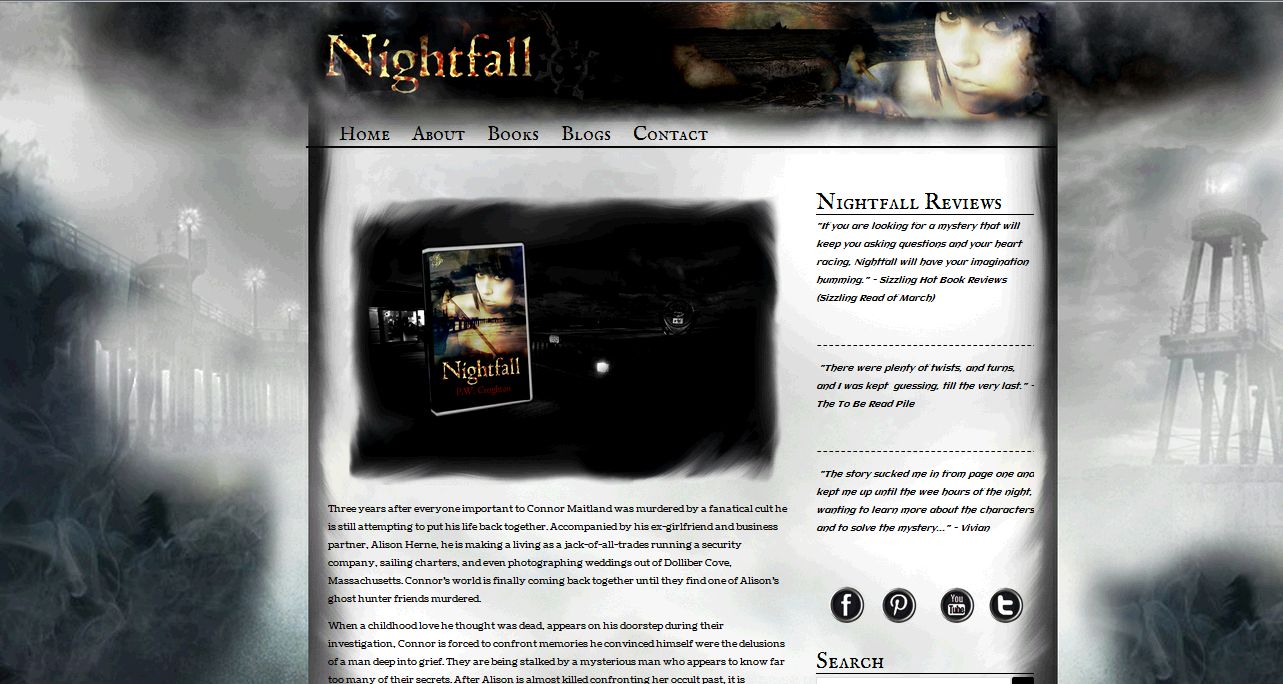
As a designer that can also develop I found myself in quite a bit of a conundrum. I had to pull myself away from writing and editing the sequel to Nightfall just to develop a platform that suited my current needs and answer all of the fundamental requirements by readers. Jody and Roni have great insights here and here.

I started scrounging around looking for inspiration, what should an author site have? What are the essential elements, what do the best author sites have in common? Well, to my dismay as a designer, I was absolutely horrified by what I found. Not only do authors violate branding rules, but also every internet marketing premise when it comes to their websites. I could only find the Huffington Post's article on the top Author websites. It was very telling, even top named authors have atrociously bad websites. It's clear that some of these authors would never make it as fresh-blood today.

So, avoiding the mistakes and aiming for a very savvy site, I wasted an entire week building a website that still didn't turn out the way I had envisioned. It was all too easy to stop and call it done, but as a writer today either just starting out or a fresh-blood author platform and branding are just as integral as the writing that you produce. This first effort cost me two weeks and it was a complete waste of time. I did not want to waste my time any further and I certainly did not want to be another of the authors where you stumble across the site and say "Wow, when was THAT built?"

It was about this time I stumbled across an article by fellow wordsmith Roni Loren that discussed her new website and how she put it together with a new platform. So, I followed her advice and gave this platform called 'squarespace' a chance. I gave it a couple of hours and thought it was terrible, I couldn't get it to do anything I wanted. Then it clicked. After perusing the squarespace boards I could get the site to do anything I wanted it to with a few clicks.

I devoted a couple hours to designing the site and with only a bit of fussing I had the entire site built and not one but two blogs constructed (including pulling in all of the Surveillance Report and comments). It was clean, modern and matches all of the needs. While it's not revolutionary in layout or styling, I love the look of it and it is me. It was completed in just a few short hours and now I'm back on track.

-Side note - Particularly proud of the design with the headers. -

 So what is the takeaway? Well, if you're a writer then you need something that defines and presents your brand but you also need something that won't hurt your writing time. Writers are some of the best individuals, and the last thing anyone wants is to hear laughter because of their heinously bad website. A website is the very structure of a writing platform it needs to be built well and it needs to cater to a host of needs including your blog.

In short, writers have precious little time. While you might be able to build, design and orchestrate a platform from scratch, it doesn't mean that you should.

Join me on my new platform www.pwcreighton.com and remember to subscribe to the new Surveillance Report there. :-)

Wednesday, April 25, 2012

Intriguing Observations: Has social media handicapped our social?

The Intriguing Observations series was created to gather some of the greatest supporters and bloggers to provide their own insight on all things creative both in their ventures and their techniques. This week on the guest series is another all-star supporter, fellow AP author and an outstanding wordsmith Bri Clark.

First of all Phil thank you so much for having me on not to mention the reminders, frankly I need them. My life is busier than a piglet on a tit. This would probably be a good place to introduce myself and explain what I do...

In a nutshell I'm a literary strategist. I own and operate Belle Consulting. The definition of just what that is has not been determined by Wikipedia at this point as it keeps changing. I'm many things to different clients. Beta reader, Publicist, Social Media Manager, Speaking Coordinator, etc etc... In conjunction with my consulting business I'm a speaker, event board member, promoter, and author.

It was while fulfilling the role as a publicist/event specialist that I came upon this observation. Linda Bernardi, my client, is an Amazon bestseller and top woman in the technology field. At an event in Seattle surrounding "The Cloud" I couldn't help but be flabbergasted by how unsocial some of the vendors were.

A conference is the place to be our most social, our most charming, to present our best! It's at these events that I make most of my leads or create long lasting contacts. Nevertheless, it seemed that several of the peers that surrounded me couldn't pull their eyes from their cell phones or laptops long enough to look at the people in front of them.

Picture it an area with tables set out in a manner that suggests flow. Black cloth and skirts cover and surround the tables. Random catalogs are set out with a free gift such as a pen. Behind the tables are one usually two people with their heads down in a laptop or a cell phone. Some of the tables didn't even have a sign at a vertical angle to say who they were. But that's another rant. I'm very much a stickler for presentation and invoking the senses. Attendees walked by several feet away the fleeting look of interest on their faces. Only they were never greeted, because they were never seen.

FAIL!!! And what's worse is it was a fail that could have been avoided. The worst was one booth where two men sat side by side for hours ( I kid you not) pounding away on their keyboards. The staccato of the keys like a alarm to the audience stating "Do Not Disturb: What's on here is more important than you are." Side by side they beat those keys as if they were in some kind of virtual email race. After watching 10 potential leads walk by I decided I might vomit or use my stun gun on their computers and ignored them.

Nonetheless, the lingering effects of the occurrence wouldn't go away. I noticed it several places around me. Granted it wasn't all but most. If they were a vendor with an elaborate interactive booth they were like the ringmaster of a circus. "Come here! Step up to my amazing product!" It was as if the tables and black table cloths were kryptonite for my fellow vendors.

Alas, no it wasn't the table cloths (Did I mention I always bring my own table cloth?) it was online social media and email. I know this for a fact because being the bold nosy southern belle that I am I walked around and looked over their shoulders.

Now I more than anyone else know that response and timing are key in our businesses. However, it is not hard to post an update or an automatic email response saying, "Hey! I'm at a conference from this date to this date. If you are in the area please come by. If this is an emergency please reference my phone number."If anything I have found people respond in a huge way to those that have lives beyond Facebook. You come back with ideas and experiences that they couldn't have.

Perhaps I'm being a little dramatic, I do have that tendency. But it really did seem that the only way some people can be social is through social media. They need the anonymity the internet provides. They require the control that editing pictures and retyping or erasing status updates enables. And because of that weakness that one contact that could open the door to their career success just passed by and they didn't even see them.

What do you think? Am I being dramatic?


Website: Belle of Boise
Twitter: @BriClark
Facebook: Bri Clark
Linkedin:
Google Plus
Buy Bri's Books on Amazon


Monday, April 9, 2012

The Artistic Product

Desire, Appeal, Demand, Art....

In any creative venture there is an element conceptual fulfillment and appeal. Often many choose to define their works as an art. These concepts demonstrate a defined expression and communicate emotion through specific aesthetic criteria, in short works that are of more than ordinary significance.

There are many different mediums that can be termed art, ranging from the standards of painting and sculpture to writing and even film or gaming. The ideal of conveying a concept through a medium in such a way as to be desirable is a fundamental motive for many artists. Through practice, refinement of technique and expression a work can be viewed as art.

While any work can be viewed as a work of art it is undeniably the aesthetic criteria that permits the work to be classified and termed "a work of art" within the medium. The aesthetics of a piece, while entirely subjective, are often representative of the 'high-concepts' that determine the appeal of the piece.

Photo Credit
As with any creative work, the determination of appeal is quite subjective however the broader the appeal the more accepted the piece is overall.

It is the appeal of a piece that many artists seek so that the work is broadly accepted as a work of art without dispute. Many artists are willing to sacrifice for the sake of their work, barely making a living while trying to find 'mainstream success' in their desired field. These Starving Artists epitomize the concept of an artist and are entirely dependent on the demand for their work.

Starving Artists and demand are where a couple of misconceptions enter.

Many writers/artists that are new to the industry often claim that their work is art as a defense to changing their work. As previously discussed, there are components to this that determine viability of their claim and then there is the misconception about the 'Best Seller' author.

The Best Seller author may have made their way into the best selling ranks but it does not mean that they have left 'Starving Artist' status. Most authors work other more permanent jobs because it often takes more than six published works and at least 2 'best sellers' before they can even consider focusing on being an author as their career.

In reality, an artist creates a work that they hope has enough appeal to drive the demand for their work including future works. Successful artists can convey their work with broad appeal but still remain truthful to their original concepts so that it is a work of art. Even starving artists who have sacrificed for their art dream of 'breaking into the business' and having their work desired. This desire effectively makes the work of art a product.

Products rely on marketability to determine success and even art needs an audience to claim success. In the writing industry success is measured in more facets than stars in the sky but claiming a work is art is not a defense against change, it only means that you'll be left by the roadside in an industry of unique artistic products.

Sunday, April 1, 2012

Assembling Art

The argument of art has always been not only a conceptual one but one of personal perception of both the product and the practice used to create that product.

A recent story that has brought into question series endings as well as artistic vision has been the whole Bioware/Mass Effect 3 ending that has managed to go from an industry specific topic to national news and even spurred Forbes to begin analyzing the industry. This is really interesting because it is an argument of artistic expression versus respect for the property for fans.

Photo Credit
Many critics and writers, even myself have dedicated significant time to analyzing writing as an artistic expression, an art form. Through comparisons in perspective, similarities in techniques across mediums including photography, film, sculpture and even performance arts, writing is about the art of creation but is that all?

The primary dispute that critics are using to defend the flawed story of Mass Effect 3 and often what many writers also rely on it the idea that it is art. The story is an art and the creator has full artistic license to craft the work however they see fit but this isn't entirely true.

"Many definitions of art have been proposed by philosophers and others who have characterized art in terms of mimesis, expression, communication of emotion, or other values. During the Romantic period, art came to be seen as "a special faculty of the human mind to be classified with religion and science"-Wiki

When an artist creates their piece of work it is what they envisioned and they are ultimately only constricted by how they perceive their own work. This entire process changes when the artist chooses to share their work with others as a career. The work then needs to become commercially viable.

In every artistic medium there are criteria that need to be addressed for the work to be accepted by enough critics and individuals to be a viable work.

What this means in short, a toddler's crayon drawing may be art to their mother but no one is likely to be buying it for thousands of dollars. In writing terms if someone writes a 200,000 word novel with the grammar of an eight-year-old and refuses to address these issues no one will publish it or want to read it.

For all of the artistic intent every work needs an outlet to be viable. In the writing industry, as in photography and film these are publishers. Publishers set criteria for all works because they have a set target market and prospects for those works already that also establish the work's commercial viability. It's an assurance that any work that they accept will be viable for them. If the artist's work does not meet their criteria then it will not be accepted or they will request it is changed to suit their criteria.

Photo Credit
Many budding writers instinctively dispute the need for changes to their work but the publisher is focusing on what is commercially viable. EVERY work is altered for publication. Some publishers require larger changes and more dramatic alterations to the piece to suit their target while other publishers will only refine the work.

When I was editing Nightfall for my publisher their requirements were fairly simple, no profanity and no trademarks. I had no problem dropping the cursing, it opened up the audience for my work but I found more difficulty with trademarks, mostly giving up car models. In the end it was just a matter of edits.

No matter the medium, if an artist wishes their work to be successful then it should be expected there will be changes that need to be met. If the artist resists the recommendations, then they should also expect the criticisms that come with that choice. While the work may be a piece of art it is also a product. If the customers are not happy with the product while the artist defends their work as art then they should know that they will have fewer customers next time.

While we regard writing as an art form, artistic expression in the finest, we should always be wary of claiming it's our artistic license to make certain choices about our work. If we want to succeed as authors we need to accept the criticisms and make the changes that make our works viable, otherwise it's not a career in writing just more unpublished works in our desk.

Monday, January 30, 2012

Author Anxiety

Anyone outside the publishing industry or even those just starting their writing journey have a distinct vision of the 'author.' The private, relaxed individual sitting in their own home office plugging away at their keyboard while downing coffee. Not that there isn't some truth to this image, most authors have more coffee in their system than blood, but TV, movies and stories romanticize this image.

The first-time author is a far cry from that idyllic vision that the entirety of the world seems to portray. In-fact the budding author is actually subject to more stress than they could anticipate.

Just starting out the writer has clear aspirations, a precise writerly dream that they want to accomplish. They receive praise and support for their work from friends, family and other aspiring writers in their circle.  The nervous anxiety that comes with sharing what was private work with the outside world is taxing but the support keeps the writer moving. 

The writer completes their work, making minor edits and revisions based on the input of those offering support. Their supporters start asking the question; "Are You Going to Get it Published?"

Constant questioning from supporters leads the writer to the publishing industry. That perfect, amazing work will now have a home, well, maybe. The writer is introduced into the confusing maze of ambitions, pitfalls, deceit and predators. It becomes a learning process, how the industry works, what is currently trending, roles of agents, editors, the author platform and the loathed query. 

Photo Credit
The writer needs to create an 'author platform.' This is basically a string of social media platforms that work together to help the writer establish a community. Blogging, Twitter, Facebook, Goodreads, Dear Author etc. These need to be tended daily to develop a community and show potential agents and publishers that the writer can establish an audience.

Stress levels skyrocket as the first-time writer is introduced to the confusing logic of 'writers need an agent to reach the publishers but most agents require the writer to have some publishing credit before considering them.' Add in an introduction to Pred-editors, and the process becomes a frustrating mess. The most trusted agencies and publishing houses have guidelines that make prisons look lenient. Generic form letter rejections flood in with little hint at why the writer is being rejected. The publishing industry seems to be an impregnable fortress with a labyrinth surrounding it. Almost 80% of writers surrender at this stage.

First-time authors do have a number of options at this juncture; they can self-publish, they can try a smaller press or maintain their persistence pursuing the traditional route. Fighting their instincts, they start making changes to the masterpiece, editing and revising the work to address the rejections.

The remarkable and persistent few manage to find their way through that mess and through a small bolt of lightning receive a publishing contract. This doesn't mean any of the stress fades at all, this only changes the goals. The writer now needs to evaluate the terms of the contract, are they fair? Does the publisher have a solid distribution network? Sure Amazon and Barnes & Noble are on the list but how far is the publisher's reach? Does it include the itunes bookstore? What about physical imprints or audio? What about media rights? Do the percentages and efforts balance? The writer has a contract and they have a longing desire to just sign but the fear of being betrayed is extremely high. 

Everything balances out, the writer signs the contract and will be a published author soon. The writer can start working on the next project.

Once again the stress levels rise as the first editor dives in while you're filling in all of the necessary paperwork. It is like working for an employer after all. At this time the publisher starts their cover-artist on your project. The editor takes your masterpiece and leaves enough red on it to make you wonder how you ever made it this far. Some things are requisite changes while most are just questioning your logic. The next project is left on hold as the writer is left to make adjustments and edits to their work. Now the writer has the pressure of the publisher to make sure the work is the best. 

Just as the writer begins to find a bit of calm in the routine engagement with the publisher, the cover-artist produces the first mock-up for their title. It looks nothing like what the writer had in mind but the writer needs to fight their instincts once more. The publisher and cover-artist know what will work, the writer can make changes if they want but it may not be advisable. At this stage the writer is introduced to the Line Editor. The last editor said the work was great but the LE goes through every single line with a microscope and scarily enough knowledge about various subjects to win big on Jeopardy. 

The writer manages to endure and completes the line edits. They can turn their attention back to working on the next project. Then the final proofs come in from yet another editor. There are barely any marks on the project now and these changes are made in no-time at all. 

After the proofs are returned come the Galleys, yet another round of edits. Things that slipped by all of the editors up to this point are caught and after a couple of checks the publisher produces the ARCs, that's Advanced Reading Copies for the newbies. It's an exciting time and the writer's work is almost on the shelves. 

Photo Credit
This doesn't alleviate stress, it only causes more. Now come the marketing efforts both from the publisher and the author. The publisher will readily produce booktrailers, get the book to all available channels and push it out to all the review sites that they have ties with and maybe even create Pay Per Click ads on Facebook, Google or Goodreads. There may also be a book tour or blog tour (more common now). The writer can not simple 'fire and forget,' letting the publisher handle all of the marketing. Depending on the publisher, the author will need to design the PPC ads and run them or set up promotions, tours and send out their book to any additional reviewers.

The writer needs that project to be a success, they need to manage the marketing, find time to write and still maintain their author platform so they can be found.

Then it hits home, even with a publisher and a novel about to be on the shelves most large review sites pass along form-letter rejections citing that they don't have enough time or aren't interested in the book. Is the project slipping already? It hasn't even launched yet and it's being relegated to the non-important pile.

Fortunately most authors have grown a thick hide by this time but the doubts still nag at the back of the mind. Then they begin to question the marketing. These review sites are great for grabbing avid readers but they do nothing at grabbing the majority of potential readers who only occasionally read. Forcing out social marketing doesn't work, it only blitzes the same audience over and over again and traditional marketing doesn't work either. Avid readers are only a small portion of sales how can the project possibly be a success?

In truth, it only takes about 100 sales-a-week (ebook) to make the top 10,000 in sales rank on Amazon. Most books are lucky to sell 1,000 copies in their sales life. So long as the novel is available on every possible distribution channel it stands the best chance but not without marketing to push it.

The anxiety of the publishing process never lets up. Even as the book hits the shelves it becomes a concern of sales and reach while the whole cycle starts again for the next project. The romantic image of the author is never fully true. The best authors have just grown accustomed to that stress and keep pushing out their work to assure they have the best possible results.    


PW Creighton: The Surveillance Report Copyright © 2011 -- Template created by PW Creighton -- Powered by Blogger