Showing posts with label depth of field. Show all posts

Tuesday, December 6, 2011

Abstracting Layers

Depth, Dimension, Layers…

As a narrative piece is composed, one of the difficulties of framing a specific point as the subject of the narrative is establishing the sense of depth in the composition.

Often a visual composition will rely on layering to add a sense of depth and even time to the piece. A narrative composition can quite frequently utilize similar techniques to bring that composition into greater focus, bring it to life.

Adding depth to a narrative is achieved through layering interaction dynamics and narrative history.

Photo Credit
Interaction dynamics are the implied and explored relationships within the narrative. These can be the relationships between subjects or between subjects and setting. Implied relationships are not overt reactions between subjects but the secondary inferred relationships. In a visual sense the subjects would be juxtaposed to demonstrate hidden emotions or draw tension. These are quite common in romantic narratives as two subjects awkwardly avoid interactions.

The explored relationships are overt dynamics, emotions and interactions are direct. Visually there are direct correlations between subjects or subjects and setting. These can be further layered with different levels of emotions, interactions and relationships. All of these are typically the make new friends, adversaries and love interests subject interactions.

The interaction dynamics of both implied and explored relationships add layers to the composition, provide a sense of depth to the interactions.

A visual composition can frequently capture a still moment in time, but it can also appear flat and superficial. While in a narrative it is possible to convey a linear progression of time, like a visual composition it can also appear flat and superficial.

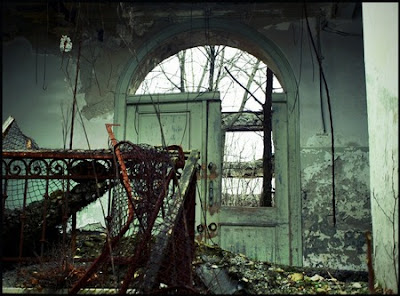
Through narrative history it is possible to layer a composition with additional depth and dimension. The composition demonstrates a history for the subjects through details of worn settings, memories of previous events and relationships built on events not within the composition.

As any visual composition becomes more interesting with layers of interaction dynamics and narrative history so to does a narrative composition. The flat one-dimensional take on a narrative timeline or strictly overt interactions leaves a flat, superficial image. Adding layers of interactions, history and detail together brings the piece to life.

Monday, November 28, 2011

Leading Lines

In a composition there are a variety of techniques that can be utilized to explore the piece. One of the most dynamic means of guiding the audience through a piece is through the use of leading lines.

Leading lines are one of the top rules of visual composition and are used to great effect to guide the viewer's perspective through the piece, drawing attention to focal points and creating narrative rhythm. These lines are also can be used singularly or with additional supporting lines.

Photo Credit
A narrative composition is led by leading lines as much as any visual composition, however unlike a visual composition the leading lines are not only visual based on the narrator's perspective but also a product of dialogue.

The narrator's perspective has a strong influence on the composition through the depth of field, viewing angle and the leading lines. Through the narrator's perspective it is possible to guide the audience through the piece in a similar fashion as a visual composition. The narrator's perception can create tension, emotion and dynamic depth through their perception of the scene. As the narrator examines a particular scene, their view will follow the same leading lines as an audience would with a visual composition.

Ex: I forced the weathered metal door open and stumbled out onto the platform. The tile was cracked and broken, covered in disturbing stains that led to the tracks. The tracks were rusted, long forgotten as they ran down the tunnel and back into the real world.


The narrators eye follows the leading lines as the audience would view it in the visual composition. The eye follows the lines of the tile in the foreground to the tracks which prominently guide the eyes down in a linear direction.

Dialog leading lines are often more clearly defined as character movement within the environment or lines that begin or end a scene. These lines convey movement not only through the visual composition but through the story as well. Often these lines are used as indicators for scene and settings change.

Ex: "Well, that's not going to matter anyhow." I heard her let out a sigh. "Fine, let's do this." I stopped and looked at her. "That's the spirit. Ready?" She nodded. I turned the knob.


The audience's perception of a narrative composition is subject to the same rules of visual compositions. Through dialogue and scene leading lines, an audience is guided through the piece in a fluid, dynamic manner that keeps the piece interesting.

Sunday, November 6, 2011

Juxtaposition of Relationships

Every narrative composition is about the dynamics of relationships, the interactions between characters that drive the piece forward. There are however, more elements to conveying those relationships than just the interactions between the sculpted characters.

As with any visual composition, the elements of a piece can be juxtaposed in a manner that can convey the specific dynamics of relationships. Through a manipulation of perspective and the details of a scene it is possible to emphasize ties or relationship dynamics, convey emotions and shared feelings, reveal occasions and shared history.

Ties and relationship dynamics in a composition are primarily a revealed through actions of the subjects but the details can clearly reveal similarities of physical characteristics, similar thoughts and perspectives. Choosing the appropriate details, it is possible to create a sense of unity between characters.

Ex. She pushed her way through the crowd when she saw Nick talking with someone at the back of the bar.

Photo Credit
In this example the atmosphere is crowded and suspicious but does not carry an emotional impact. If the perspective and focal points are adjusted it becomes significantly stronger.

Ex. She pushed her way through the crowd and stumbled to a halt. Nick was sitting with some redhead at the back of the bar.


Utilizing the relationship between subjects and the setting makes it possible to convey emotions and shared feelings in a subtle cohesive manner that prevents any jarring disconnections between the audience and the piece. When conveying a specific subject matter the composition is arranged to a 'telling-effect' that reveals the emotional impact rather than reactionary from the subjects.

Ex. The struggle caused the camera to slip and tumble over the side of the boat. We bolted to the railing and watched helplessly as it splashed into the water.


The entire scene is predicated on actions and the relationship between the subjects and objects in the scene. While no dialog or emotions are revealed the juxtaposition of the elements creates the emotion. The same can be created with the use of objects alone in a composition.

Ex. The light followed the red droplets along the darkened corridor only stopping when the source was revealed. A simple folding knife with dark stains on the glinting metal.

 Often compositions utilize occasions such as holidays, birthdays or other special occasions to create a sense contrast for the subject material. A more subtle use of objects and subjects in the composition is utilizing and emphasizing the shared history of the subjects. Referencing a single previous event, high school slogan years later or other telling moments.

A narrative composition is no different than a visual composition, the relationship between objects, details and subjects affect the overall piece. Choosing the appropriate emphasis, focal points and providing the right juxtaposition between the elements creates a stronger composition. Any single element can be enhanced to affect the overall piece.

Tuesday, October 25, 2011

Analyzing the Angle

Composition, Framing, Angles….

In any composition there are a variety of facets that can impact the composition as a whole. Elements such as lighting, perspective and depth of field for the piece can adjust the overall tone, perspective and even objective for the entire composition.

As with any composition in the visual arts, one of the most significant facets of to keep in mind is the angle of the 'shot.'

Photo Credit
While there are many conceivable angles to approach a scene from the two most important framing angles are the 'low shot' and the 'top down' shots. The low shot is commonly used in compositions where emotion is the principle objective. Focusing on a subject from a low angle creates a sense of overbearing pressure, authority or menace. The opposite is true for the 'top down' shot. Often used in compositions to show scale and distance the audience from subject matter, it is possible to convey a sense of insignificance.

In any narrative, each scene is perceived from a specific angle and perspective. As with most instances of first-person narratives, the angle of the scene is restricted to the available and logical perceived approaches by the narrator. The narrator is restricted to human perspectives, angles on scenes. This perspective may appear limiting but as the creator of the composition, it is possible to move the scene to accommodate a stronger impact.

Ex. I jogged down the hallway towards the figure looming over the latest victim. I was too late.


In this example the angle of the scene is perceived at distance on the same plane, the same level as the scene. Adjusting the angle and scene to create a better impact…

Ex. I jogged to the stairs and started up until I found the next victim. I knelt on the landing and cursed myself. Too late, again. Lifting my gaze, I saw the figure looming at the top of the stairs watching me.


As the angle on the scene changes so does the emotional impact and tone of the scene. If the scene is reversed and the angles change again so that it is a 'top down' angle then the perceptions change with it.

Ex. I jogged to the top of the stairs. He was standing over his next victim on the landing below. I was too late again.


In these examples the tone and perceptions of the scenes change giving a completely different tone to the composition each time. In the first example, the perceptions range from the antagonist may be caught, fight or flee. The second example, the perceptions range from sadness to fear that the character may be the next victim and in the final example the perceptions are that the antagonist may flee or be caught.

While the composition may have many facets that impact the overall tone, the angle of the 'shot' is one of the strongest elements for controlling the narrative perceptions. In a third person perspective, it is far easier to control the angle of the shot but it is also more difficult to convey the same level of emotion as the 1:1 ratio of the first person perspective. Every detail, perspective and angle has attributes that lend itself the certain compositions. It's the director, the creator's challenge to understand these and create the ideal composition.

How do you perceive the angles?

Monday, September 26, 2011

Macro-Composition

Every composition has a set of defined elements from depth of field to subjects to the very contrast of the details in a piece. There is however, no set scale for any piece.

The challenge of any creative piece is utilizing all of the elements to form a connection with the audience, to give that emotional bond that keeps their attention, makes them want to understand. In a narrative this can mean perspective in the piece or scale of the subject matter (Will it affect the world? or Just a few lives?) or this can mean the very length of a piece.

Building a connection between the audience and the composition can be achieved through a variety of methods but the strongest is creating the 1:1 connection, a Macro-connection.

Photo Credit
In photography, establishing a 1:1 connection between the audience and the subject is achieved by focusing intently on the minute details of a larger subject. The Macro-composition is created by selecting the details of a larger composition that best represent the larger piece and then making them larger than life, a direct 1:1 ratio.

Eg. The larger composition is a broken down and forgotten home, now overgrown with trees and is slowly collapsing as autumn sets in with the early morning sun. The Macro would be a close up shot of the neglected flowerpots along the fading stucco wall with a few fall leaves resting on the pots with a hint of the early morning sun.

Creating a Macro-composition in a narrative can be one of the more difficult things for a writer to accomplish. It is often easier to express the larger implications of a narrative by breaking the 1:1 connection. In a third-person perspective it is common for global effects to be viewed by jumping to an outside narrative character that can witness these. This breaks the 1:1 ratio and the essential 'spell' that the audience is under however, and the last thing any writer wants to do is break their audience-composition connection.

There are a number of ways to express a larger composition within the details of a given scene or event without breaking the Macro-compostion. To borrow the phrase from Rohe ~ "The Devil is in the Details."


Controlling the focal point of a composition and through a clever use of details it is possible to express the larger composition without breaking the Macro 1:1 connection. These practices are easily attributable to Macro-Compositions, telling an entire narrative in a few precisely chosen details and words.

One of the strongest practices comes from utilizing video as art. The Macro-Challenge consists of creating 4 video clips under 15 seconds each, the catch is they need to be 'Non-Symbolic' but convey an emotion. In short, it means to convey love the cinematographer can not use hearts, flowers the color red, people etc. Through this practice the cinematographer learns to take explicit care in developing every 15 seconds.

In a narrative, the desire to focus on larger details can inhibit the audience-composition connection or even break that connection if the wrong focal points and details are selected. The solution is to utilize the Macro-Challenge of cinematographers. Many of these challenges are currently floating around including Twitter-Fiction and Flash-Fiction among the many other variants. Taking specific care to craft a narrative in a sentence or two encourages a conscious selection of words and details. As the short sentence is perfected then that same approach can be brought to the paragraph, the chapter, the novel and ultimately the series.

Every composition, every narrative has a Macro-perspective embedded in the piece. Utilizing precise details can convey a larger composition without ever breaking the 1:1 connection with the audience.

Tuesday, September 20, 2011

High Dynamic Composition

In any composition there are a variety of factors that can either detract or enhance the piece. While the depth of field and the subjects of the composition are considered 'fixed' or 'unchangeable,' many elements ranging from contrast to saturation to detail can be altered to enhance the piece.

One of the most important elements of a composition is establishing the appropriate contrast in the piece, contrast of light and shadow, contrast of subjects and contrast of elemental details.

Often, those in the visual arts use a technique called 'bracketing' or 'stepping' to find the right balance in a composition. The technique consists of increasing and decreasing the amount of exposure, or light in the shot to establish different details and find the best result.

Photo Credit
Abstracting this technique to narratives, it is not too dissimilar from establishing revisions to a draft. The draft creates the basic composition with an established depth of field and subjects but does not have the strength of an emotionally draining 'dark' composition or the emotional highs of the 'light' composition. Each step towards the 'darker' or 'lighter' compositions can shift the entirety of the piece but at the same time, finding the right composition can be extremely difficult. Most take each piece of the composition and adjust it individually to suite the piece. This can result in a lengthy and painful process to attain the desired composition.

A very beneficial technique that supplements 'bracketing' in the visual arts is known as High Dynamic Range imaging. This technique involves taking the variations of a composition, the lightest highlights to the darkest shadows and merging them into a solitary composition that will have exceptional contrast and all of the positive elements from each variation.

While revisions can be painful, the concept of taking a single draft and revising it into separate directions, applying a lighter tone so the high points are the brightest, then taking another variation and revising with the intent of taking the dark moments and making them the darkest they can be is very beneficial. The end result of creating separate, bracketed, revised compositions allows the creator to merge all of the strongest elements into one HDR Composition.

How do you revise your work? Do you use an HDR technique or do you adjust the individual elements of the original piece?

Tuesday, September 6, 2011

Assigning Depth of Field


As the artist conceptualizes their work, they designate a specific subject or focus for that work. There is a particular message that they wish to convey with their subject and as a result, a given selection of details that must be emphasized in their work.

In a particular work, the artist will need to select the appropriate 'focus' for the piece. This focus will reveal a subject in greater detail while de-emphasizing the surrounding subjects to provide a greater contrast that allows the subject to stand out. This technique of emphasizing a particular subject with a selected focus is commonly described as a depth of field in photography and cinematography. In a visual sense it is the distance between the nearest and farthest objects in frame that appear 'acceptably sharp.'

Photo Credit
Much like the visual arts, it is just as necessary and integral to select the appropriate focal length, the depth of field for a piece. Three primary means of focusing on a subject across mediums include the deep focus, shallow focus and a selective focus.

A deep focus or large depth of field is common in cinematography and is also quite common in fantasy novels as well. In a deep focus shot the foreground, middle-ground and background are all in focus. This emphasizes moderate detail across all planes of the frame and in narrative terms this is revealed as detailed descriptions of the world, characters, atmosphere even political machinations. While there will be given subjects within the frame they will only exhibit an equal level of detail as that of the rest of the frame regardless of positional emphasis(if they're the main characters, subjects, etc.).

Ex: The rusted mechanical horse slowed its piston-timed pace until it brought the carriage to a stop before us. It was clear that the Algenie were being selective about transit updates in this section of the city. "Select your destination sir." The robotic voice echoed.

The counterpoint, a shallow focus or small depth of field is often more effective. In a shallow focus the subject is emphasized while de-emphasizing the foreground and background. This emphasizes great detail on a single plane and significantly less detail on surrounding subjects and in a narrative sense, is common in most contemporary novels. The subjects in frame will exhibit varying levels of detail depending on their positional emphasis.

Ex: The cab swerved across traffic in response to my hail drawing to a stop in front of us. I jumped in and tried not to recoil at the stench. The cabbie looked over his shoulder, "Where to boss?"


A balance between the shallow focus and deep focus is the selective focus, a large depth of field with selected emphasis. This focal method allows for a larger detailed frame than a shallow focus but also provides more detail than a deep focus on selected subjects in the frame. In a narrative sense this is more uncommon but also generates an air of inconsistency.

Ex: The battered yellow cab swerved around the sanitation truck as the workers hopped off. The car dodged a pristine Mercedes and slid to a stop in front of me almost taking my toes off the curb. I shook my head as horns sounded in the distance and I pulled the door handle. The scent of sweat and decay greeted me as I slid in on the cheap vinyl seat. "Where to boss?" The large cabbie asked with a thick Brooklyn accent.


Every creative piece has a selected depth of field, a focal length that establishes what in frame is emphasized and de-emphasized. Once a focal length is selected, it is abundantly apparent to the audience when that focal length changes. If there is a shift within the focus it often weakens the piece and often distinguishes a professional piece from the amateur. Do you know what focal length you're using?
 

PW Creighton: The Surveillance Report Copyright © 2011 -- Template created by PW Creighton -- Powered by Blogger